

Imagine sitting in a crowded Phoenix urgent care lobby for two hours, surrounded by coughing strangers, just to spend five minutes with a provider. It’s a frustrating cycle that drains your time and energy when you’re already feeling your worst. You deserve professional medical advice, but the traditional waiting room experience often feels like more trouble than it’s worth.
We understand that you might feel skeptical about whether a virtual doctor in Phoenix can provide an accurate diagnosis without a physical exam. You’re likely also concerned about insurance hurdles or technical glitches during your call. This guide will walk you through exactly how to prepare for a seamless medical consultation from the comfort of your home. You’ll learn which conditions are best suited for telehealth, how to verify your coverage, and the specific steps to take for a successful, stress-free appointment. By the end of this checklist, you’ll know how to secure a digital treatment plan that brings immediate relief without ever leaving your couch.
Key Takeaways
- Discover how a virtual doctor provides a licensed, secure alternative to the traditional waiting room, saving you significant time and stress.
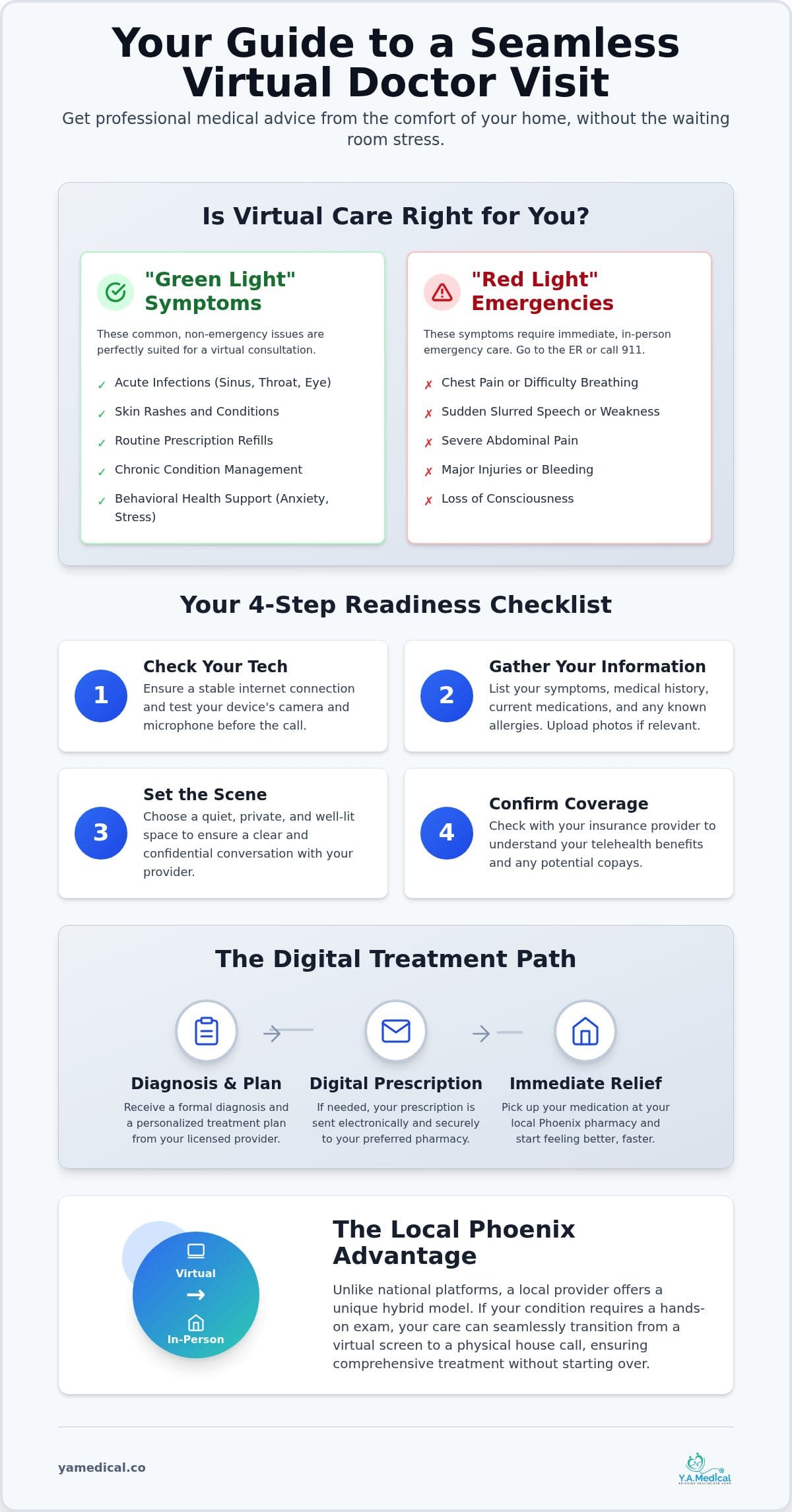
- Learn to identify “green light” symptoms that are perfectly suited for digital consultations, from acute infections to routine prescription refills.
- Master a simple readiness checklist to ensure your technical setup and medical history are prepared for a seamless, professional visit.
- Understand the digital prescription process and how your treatment plan is routed directly to your preferred Phoenix pharmacy for immediate relief.
- Find out why choosing a local provider allows for a unique hybrid model, including the ability to transition from a screen to a house call if your condition requires physical care.
What is a Virtual Doctor? Understanding Telemedicine in 2026
A virtual doctor is a licensed medical professional who provides clinical care through secure digital channels, typically via high-definition video or phone calls. In 2026, this model has moved far beyond being a simple "convenience" for busy schedules. It’s now a primary standard of care across Arizona. Modern medicine recognizes that many acute conditions don’t require a physical exam room; they require an expert’s eyes and a fast, accurate treatment plan. By choosing a virtual doctor, you’re opting for a specialized clinical workflow designed to deliver results without the delays and exposure risks of a traditional waiting room.
Safety and privacy are the foundations of this digital shift. Your medical data stays protected through sophisticated, HIPAA-compliant encryption. These platforms ensure that your consultation remains entirely private, just as it would be behind the closed door of a clinic. The primary goal of this service is immediate triage. Your provider assesses your symptoms, provides a formal diagnosis, and creates a treatment plan that often includes prescriptions sent directly to your local pharmacy. It’s about getting you the care you need the moment you feel ill.
The Difference Between Telehealth and Telemedicine
People often use these terms interchangeably, but the distinction matters for your insurance and your medical records. Telemedicine refers specifically to clinical services. This includes the actual diagnosis and treatment of a condition by a provider. Telehealth is a broader umbrella that includes administrative tasks, patient education, and remote healthcare management. When you book a visit for an acute illness, you’re engaging in telemedicine. Understanding this helps you confirm that your insurance provider recognizes the visit as a formal medical encounter, ensuring your claims are processed correctly.
How Virtual Doctors Use Digital Diagnostic Tools
You might wonder how a provider can accurately diagnose you through a screen. Modern technology provides several ways to bridge the physical gap:
- Visual Assessments: High-definition video allows providers to inspect throat inflammation, skin rashes, or eye infections with remarkable clarity.
- Photo Reviews: You can upload high-resolution photos of specific areas before your call, giving the provider a static, detailed image to analyze alongside the live video.
- Wearable Integration: Many patients in 2026 utilize smartwatches or home devices to share real-time data like heart rate, oxygen saturation, and body temperature.
These tools allow your provider to gather the objective data needed for a confident diagnosis. If your condition requires a more hands-on approach, a local service like YA Medical can seamlessly transition your care from a digital screen to a physical house call, ensuring no part of your health is left to chance.
Virtual Care Checklist: Is Online Care Right for You?
Before you book an appointment, you must determine if your symptoms are a "green light" for digital care. A virtual doctor excels at treating acute, non-emergency issues that don’t require immediate imaging or complex lab work. If you’re battling a sinus infection or need a routine medication adjustment, staying home is the smarter clinical choice. It prevents you from spreading germs or catching a new illness in a crowded lobby. This model turns your living room into a private exam space, allowing for a focused conversation about your health without the distractions of a busy clinic.
Chronic condition management is another area where digital visits provide high-value care. If you need a refill for blood pressure medication or a non-controlled thyroid prescription, a quick video call confirms your progress and keeps your treatment on track. Behavioral health support is also a rapidly growing sector. Many patients find that discussing anxiety or stress from a familiar, comfortable environment leads to a more open and productive clinical encounter. It removes the barrier of travel, making it easier to maintain consistent follow-up appointments.
Safety remains the top priority. You should bypass a digital screen and head to an emergency room immediately if you experience chest pain, difficulty breathing, sudden slurred speech, or severe abdominal pain. Virtual care is a powerful triage tool, but it’s not a replacement for life-saving emergency intervention. For most other common ailments, a digital consultation provides the fastest path to a treatment plan. If you prefer speaking with a provider directly, urgent care by phone is another fast, accessible option that connects you with a licensed professional without requiring a video setup.
Common Conditions Treated via Virtual Visit
Most patients utilize these services for everyday health hurdles. You can find more detail in our guide on what can telehealth treat, but the primary categories include:
- Upper respiratory infections, persistent allergies, and painful sinus pressure.
- Minor skin conditions, such as rashes, hives, or localized infections.
- Urgent prescription refills and medication adjustments for chronic issues.
- Urinary tract infections (UTIs) and other common bacterial concerns.
Arizona-Specific Health Triage
Living in the Phoenix valley presents unique health challenges that national platforms often overlook. During our 110-degree summer days, early-stage heat exhaustion is a frequent concern. A provider can assess your hydration levels and guide you through specific recovery protocols before the situation escalates into a crisis. Similarly, the seasonal allergy surges in the Phoenix valley can be intense. A local provider understands these specific environmental triggers and can prescribe targeted relief. If you’re feeling under the weather, booking a telehealth urgent care consultation is the most efficient first step toward feeling better without navigating Phoenix traffic.
Preparing for Your Appointment: A Patient’s Readiness Checklist
A successful medical consultation depends on more than just clicking a link. While a virtual doctor provides the expertise, you provide the environment and the data. Taking ten minutes to prepare your space and your information ensures that your provider can focus entirely on your diagnosis rather than troubleshooting your connection. This preparation transforms a simple video call into a high-quality clinical encounter that rivals any in-person visit. Efficiency is the goal; the better your setup, the faster you get your treatment plan and start feeling better.
Beyond the technology, your provider needs objective data to make an accurate assessment. If you have basic medical tools at home, use them before the call starts. Measuring your temperature, checking your weight, or using a smartwatch to note your resting heart rate gives the provider a head start. These "self-triage" vitals act as the digital version of the preliminary check-up a nurse performs in a clinic. When you’re ready with these numbers, you maximize every second of your provider’s time.
The Technical Readiness Checklist
Technical glitches are the leading cause of stress during telehealth visits. Follow these steps to ensure a smooth connection:
- Lighting and Visibility: Position yourself in a well-lit room with the light source in front of you. This allows the provider to see skin tone, throat inflammation, or eye clarity without shadows.
- Network Security: Always use a private, password-protected Wi-Fi network. Public hotspots in coffee shops or libraries don’t offer the security or the bandwidth required for a HIPAA-compliant medical call.
- Device Performance: Close all background applications on your phone or computer. Streaming services or large downloads can cause video lag, which disrupts the flow of your consultation.
- Audio Clarity: Use headphones with a built-in microphone if you’re in a shared space. It ensures your provider hears you clearly while maintaining your privacy.
The Medical Information Checklist
Your virtual doctor needs a clear, concise picture of your health history to provide a safe diagnosis. Have the following details written down or ready to copy-paste:
- The One-Sentence Summary: Define your primary symptom and its duration. For example: "I have had a sharp pain in my right ear and a 101-degree fever since yesterday morning."
- Medication List: Include every prescription, over-the-counter med, and supplement you’re currently taking. Dosages are critical for preventing drug interactions.
- Pharmacy Details: Know the name and the specific cross-streets of your preferred local pharmacy. In a sprawling city like Phoenix, this ensures your prescription is routed to the correct location for immediate pickup.
By arriving at your digital appointment with this information, you move straight to the solution. It’s the most effective way to ensure your care is both thorough and incredibly direct.
Prescriptions and Follow-Ups: What Happens After the Call?
Once the camera turns off, the path to recovery moves from a digital screen to your local pharmacy. Your virtual doctor initiates a streamlined treatment plan immediately. This process usually includes an e-prescription and a digital summary of your care instructions. You’ll receive clear notes on dosage, potential side effects, and exactly what to do if your symptoms don’t improve. This organized approach ensures you don’t have to rely on memory when you’re feeling unwell. It’s a structured transition from consultation to active recovery.
Certain medications, specifically controlled substances like high-potency painkillers or specific stimulants, cannot be prescribed by a virtual doctor due to federal and state regulations. These laws are in place to prioritize patient safety and require a physical assessment before such prescriptions can be issued. For common acute needs like antibiotics, inhalers, or skin creams, the digital process is seamless and fast. Your provider will also outline a timeline for when you should expect to see improvement, giving you a clear benchmark for your recovery.
How Prescriptions Work in Telehealth
E-prescribing is the standard for modern care. Your provider routes your medication directly to your preferred Phoenix-area pharmacy using a secure electronic system. This eliminates the need for paper slips and reduces the risk of transcription errors. Most digital scripts are processed within an hour, though you should always call the pharmacy to confirm they’ve filled the order before driving over. Regarding insurance, Arizona’s telehealth parity laws generally require insurers to cover virtual prescriptions the same way they would for an in-person visit. If a specific medication requires prior authorization, your provider’s team handles the paperwork to minimize delays.
When Virtual Care Isn’t Enough: The Next Steps
A digital consultation is a powerful tool, but it’s not the final step for every patient. If your symptoms worsen or you develop red flag signs like a rising fever or new respiratory distress, you must seek physical care. You can easily request your digital medical records to share with your primary care physician for long-term management. If your diagnosis requires bloodwork or imaging, your provider will refer you to a local diagnostic lab. For those in the Phoenix valley, YA Medical offers a unique advantage. If your condition proves too complex for a screen, we can transition your care to a telehealth urgent care follow-up or a physical house call, ensuring you never fall through the cracks of the healthcare system.
Why a Local Phoenix Provider Beats National Virtual Platforms
National telehealth giants often prioritize volume over individual context. When you connect with a generic virtual doctor through a massive aggregator, you’re often speaking with someone who has never stepped foot in Arizona. They might follow a standard diagnostic script, but they lack the local intuition required for high-quality care. A provider based right here in the Phoenix valley understands our unique environmental factors. They know how haboob dust affects respiratory health and how the extreme summer heat mimics other illness symptoms. This local expertise ensures your diagnosis is grounded in the reality of your surroundings.
Choosing a local practice also eliminates the "faceless doctor" syndrome. Instead of being a number in a national queue, you’re a patient in a community-focused system. Local providers have established relationships with Phoenix specialists and diagnostic centers. If you need a specific lab test or a referral, the coordination happens within a network they actually know. This familiarity speeds up your care and ensures that your medical history isn’t just a file on a server; it’s a record managed by people who understand the local healthcare landscape.
Seamless Transition to Mobile Urgent Care
The most significant limitation of national platforms is that their care ends at your screen. If a virtual doctor on a national app realizes you need an IV for dehydration or a physical exam for a suspected infection, they simply tell you to go to an urgent care clinic. You’re back in the very waiting room you tried to avoid. YA Medical bridges this gap with a hybrid model. If your virtual consultation reveals that you need hands-on treatment, we don’t send you away. We can transition your care directly to our mobile urgent care units. A licensed provider arrives at your Phoenix home to deliver the physical care you need, maintaining a single, cohesive treatment plan without the stress of starting over at a new facility.
Personalized Care in the Phoenix Valley
You shouldn’t have to choose between digital convenience and personalized attention. By staying local, you support a practice that is invested in the health of our community while enjoying the same premium technology as national platforms. It’s the most efficient way to manage your health in a city as large and complex as Phoenix. You get the speed of a digital visit backed by the reliability of a physical house call if the situation changes. Your time is valuable, and your health is personal. Your medical care should reflect both. Schedule your virtual doctor visit with YA Medical today and experience a modern healthcare model designed specifically for your life in Arizona.
Secure Modern Care from Your Living Room
You now have the tools to navigate a digital consultation with confidence. By preparing your medical history and selecting a provider who knows the Arizona landscape, you eliminate the stress of traditional urgent care. You’ve learned how to verify your technical setup and what to expect during the prescription process. A virtual doctor is your first line of defense in a modern, efficient healthcare system that prioritizes your comfort.
YA Medical provides a superior alternative to national platforms by offering Arizona-licensed providers with same-day availability. We offer a unique safety net; if your condition requires physical attention, we can transition your care to a mobile house-call backup right here in Phoenix. This hybrid approach ensures you receive comprehensive support from diagnosis to recovery without ever stepping foot in a crowded lobby. It’s medical care designed for the way you live today.
Book a Virtual Doctor Appointment with YA Medical and take the first step toward immediate relief. You deserve professional care that respects your time and your space. Start feeling better today.
Frequently Asked Questions
Is a virtual doctor visit as effective as an in-person visit?
Virtual visits are highly effective for diagnosing acute conditions like sinus infections, rashes, or UTIs. Your provider uses high-definition video to perform visual assessments that often replace the need for a traditional office visit. While some complex issues require physical labs, most common ailments are resolved safely through digital triage and treatment planning. This approach saves you time while delivering the same clinical accuracy you expect from a walk-in clinic.
Can a virtual doctor prescribe antibiotics or other medications?
Yes, a virtual doctor can prescribe antibiotics, inhalers, and many other medications for acute issues. Once your diagnosis is confirmed, the script is sent electronically to your local Phoenix pharmacy for immediate pickup. Note that federal laws prohibit the virtual prescription of controlled substances, which require an in-person evaluation. This ensures your treatment is both fast and compliant with safety regulations.
Does my insurance cover virtual doctor appointments in Arizona?
Most insurance plans in Arizona cover telehealth visits similarly to in-person appointments. Arizona’s telehealth parity laws generally require private insurers to reimburse for virtual care at the same rate as physical visits. It’s always best to verify your specific coverage with your provider before your consultation begins. This ensures you aren’t hit with unexpected costs for choosing a more convenient and modern care model.
What happens if the virtual doctor determines I need physical care?
If your condition proves too complex for a screen, YA Medical offers a seamless transition to a physical house call. Instead of heading to a waiting room, our mobile urgent care units can arrive at your Phoenix home to provide hands-on treatment. This ensures your care remains consistent within a single local system. You won’t have to repeat your medical history to a new set of providers.
How do I prepare my child for a virtual pediatric appointment?
Preparation is key for a successful pediatric visit. Keep your child in a comfortable, familiar environment and have a favorite toy nearby to keep them calm during the call. Have their current weight, temperature, and any visible symptoms ready to show the provider. It’s often helpful to perform a "test call" with the child to normalize the experience and reduce any anxiety they might feel.
Are virtual doctor visits private and HIPAA-compliant?
Yes, all professional virtual consultations use encrypted, HIPAA-compliant platforms to protect your health information. These secure connections ensure that your medical data and video stream are shielded from unauthorized access at all times. Your privacy is both a legal requirement and a clinical priority, meaning your digital exam room is just as private as a physical one in a traditional medical office.
How long does a typical virtual medical consultation last?
A typical medical consultation lasts between 15 and 20 minutes. This timeframe is intentionally focused on your specific symptoms, diagnosis, and immediate treatment plan. Because there’s no travel, parking, or waiting room time involved, the entire process is significantly more efficient than a traditional clinic visit. You get the professional attention you need without the unnecessary administrative delays common in large hospital systems.
Can I use a virtual doctor for a DOT physical or specialized exam?
No, specialized exams like a DOT physical require a hands-on physical assessment and cannot be completed through a virtual doctor visit. These exams involve specific diagnostic tests, such as vision and hearing checks, that must be performed in person. However, commercial drivers who need to stay compliant without the hassle of a traditional clinic can explore a mobile DOT physical Phoenix service, which brings a FMCSA-certified examiner directly to your location. You can use a digital visit to discuss your health history or manage chronic conditions before scheduling your mandatory physical exam at a clinic.